
Google FILM
Google's AI frame interpolation research code for large motion.
Upvotes
0
Pricing
Free
Category
Video Enhancers
In the database since
Oct 2026
Overview
About Google FILM
Google FILM is a free AI research project for frame interpolation. It turns near-duplicate photos into smooth slow-motion footage. FILM stands for Frame Interpolation for Large Motion, and it handles big camera moves well. It suits researchers and developers working with video. The code is open on GitHub with demos on Colab and Hugging Face. Check the repo for the current code and paper before you start. Frame interpolation means the AI draws new frames between two photos to fake smooth motion.
Key Features
1. Large-Motion Focus
FILM is built for big movements between frames. Most tools only handle small, gentle motion.
2. Single-Network Design
One neural network does the whole job. It needs no extra optical flow or depth models.
3. Slow-Motion From Photos
Near-duplicate photos become footage that looks shot on video. Two stills turn into smooth motion.
4. High-Res Support
The tool can split big images into blocks for high resolution work. This helps with large video frames.
5. Ready Demos
Try it in the browser via Hugging Face Spaces or a Colab notebook. No install is needed for a test.
Frequently Asked Questions (FAQ)
What is Google FILM used for?
It adds new frames between photos to make smooth slow-motion video. It is built for large motion.
How does it work?
A neural network studies two or more images and draws the frames between them. One network does the whole job.
Do I need to install anything to try it?
No. Web demos run on Hugging Face Spaces and Colab. You only install code if you want to run it yourself.
Is the code still maintained?
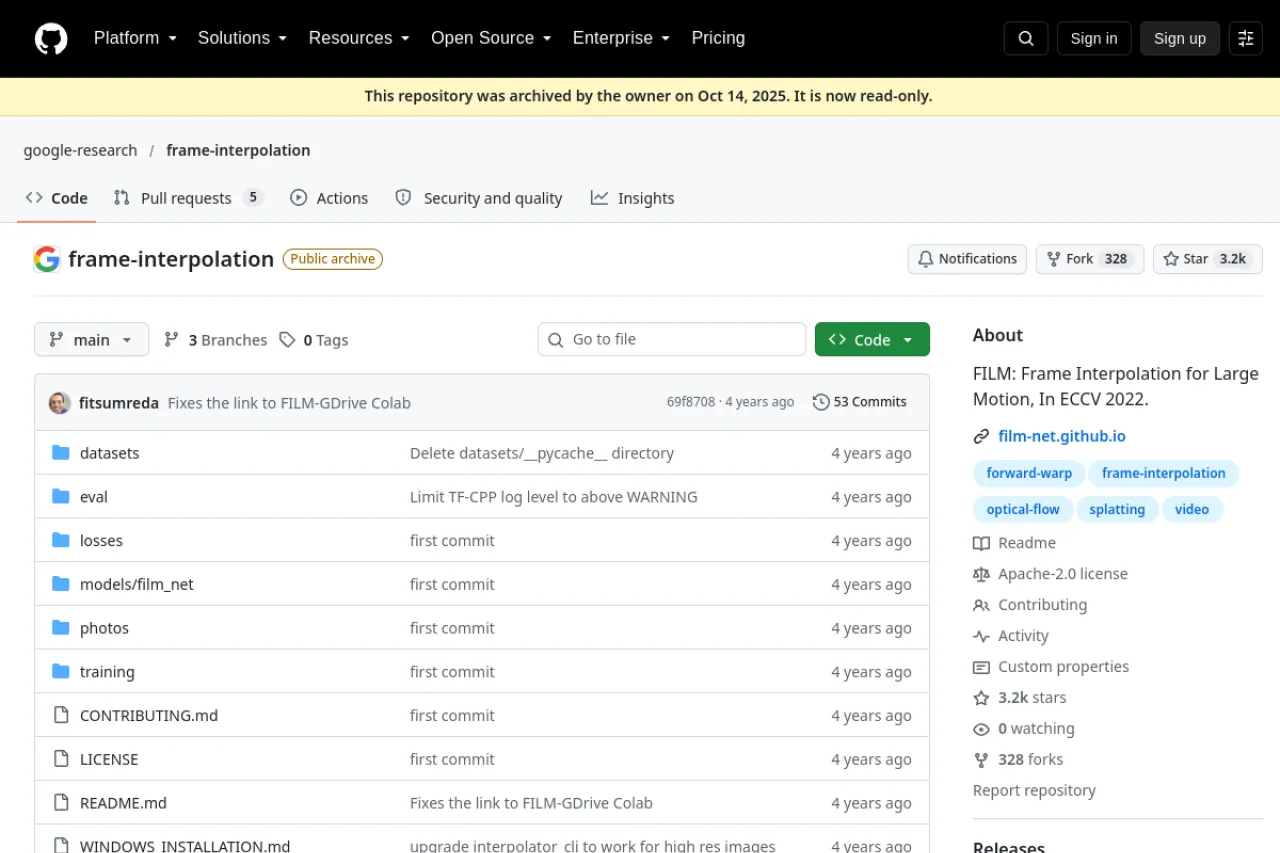
The GitHub repo was archived in October 2025, so it is read-only now. The code and demos still work.
What paper is it based on?
It is the official code for 'FILM: Frame Interpolation for Large Motion,' shown at ECCV 2022 by Google Research.
Conclusion
Google FILM is a neat AI tool for slow-motion video. It suits researchers and developers in video work. The single-network design handles large motion well. Demos run in the browser for free. Check the GitHub repo for the current code and paper before you start today. Note the repo is archived, so expect no new updates.
Keep exploring
Similar AI tools
Ranked by the job they do, their capabilities, and how closely they fit this workflow.