

Upvotes
0
Pricing
Open Source
Category
Prompt Generators
In the database since
Oct 2026
Overview
About LMQL
LMQL is a programming language for interacting with large language models. It was created by the SRI Lab at ETH Zurich and is open source under the Apache 2.0 license. It makes prompting robust and modular with types, templates, and constraints. Instead of hoping the model follows your format, you declare rules in code and the runtime enforces them. An optimizing runtime keeps queries fast and cheap. The site offers docs and a playground, plus newer support for nested queries.
Key Features
1. Constrained Variables
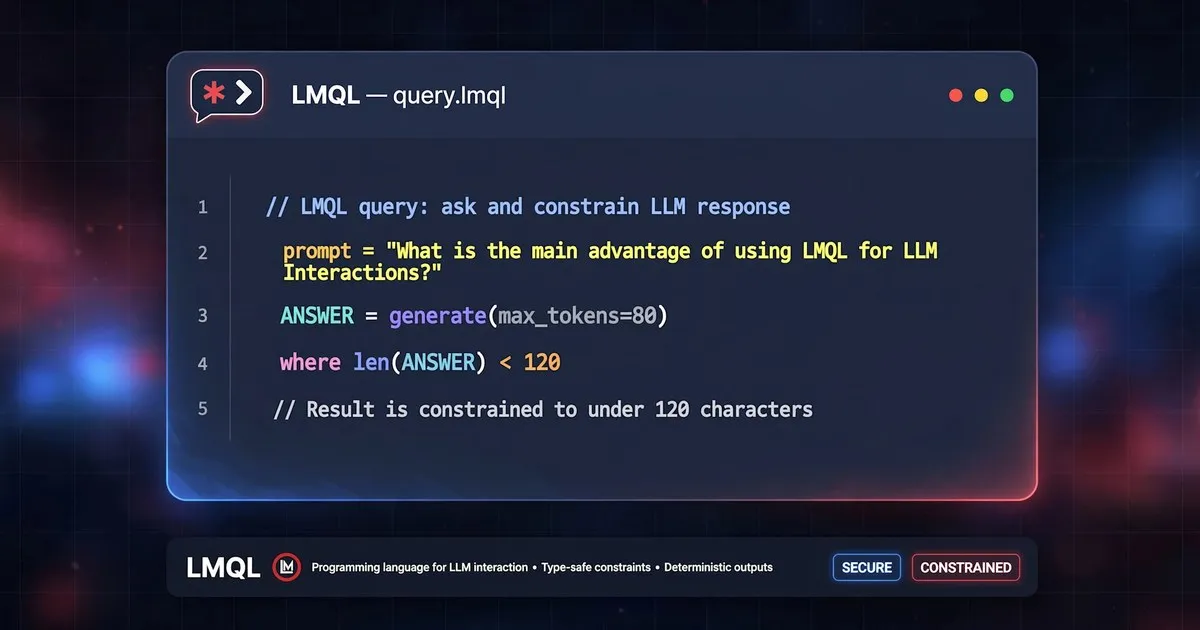
Declare what the model may generate, like [ANSWER], and attach rules the output must follow.
2. Where Clauses
Add conditions such as length limits or stop phrases that every single answer must satisfy.
3. Typed Variables
Get guaranteed output types, like integers, straight from the model with no extra parsing code.
4. Nested Queries
Break big prompts into reusable nested pieces, so complex logic stays modular and highly readable.
5. Optimizing Runtime
The runtime plans each query to cut latency and token waste during constrained text generation.
6. Browser Playground
Try LMQL without installing anything by using the interactive playground on the official site today.
Frequently Asked Questions (FAQ)
What is LMQL?
A query language that brings programming structure, types, and constraints to LLM prompting.
How do constraints work?
You write them as code, and the runtime enforces them while the model generates.
Who created LMQL?
The SRI Lab at ETH Zurich, together with open-source contributors.
Can I try it without installing?
Yes. The official site has an interactive playground for running queries in the browser.
What license does LMQL use?
Apache 2.0, a permissive open-source license.
Conclusion
LMQL is for developers who want guarantees, not guesses, from language models. Constraints turn flaky prompts into dependable programs. The playground makes it easy to learn, and the open-source license keeps it free to use. Write one constrained query today and feel the difference structure makes in your next project. It suits both small scripts and bigger pipelines.
Keep exploring
Similar AI tools
Ranked by the job they do, their capabilities, and how closely they fit this workflow.