
Upvotes
0
Pricing
Open Source
Category
3D Tools
In the database since
Oct 2026
Overview
About Point-E
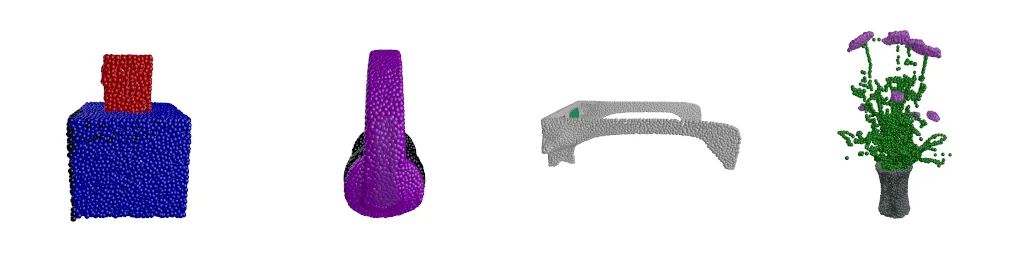
Point-E is OpenAI's open-source code for generating 3D point clouds from text or images. A point cloud is a set of 3D dots that together describe a shape. It uses a two-stage diffusion pipeline: a base model creates a coarse cloud, and an upsampler adds detail. An included SDF model can turn clouds into meshes. It is a research codebase for ML developers, not a hosted app. Code is MIT-licensed on GitHub. Pretrained checkpoints download automatically on first run. Check the repo for install steps.
Key Features
1. Text-to-3D Point Clouds
Sample point clouds straight from text prompts with the included notebook. The small text model handles simple categories and colors.
2. Image-to-3D Point Clouds
Generate a point cloud conditioned on a synthetic view image. Visual input gives more control than text alone.
3. Cloud-to-Mesh Conversion
An SDF regression model converts point clouds into meshes. SDF means a math field that describes surfaces.
4. Ready Notebooks
Three Jupyter notebooks cover text-to-cloud, image-to-cloud, and cloud-to-mesh. Each step runs as a guided example.
5. Eval Metrics
P-FID and P-IS scripts benchmark generation quality for point clouds. Researchers can compare models on standard scores.
6. Easy Install
Installs with pip from the repo in one command. Checkpoints like base40M download automatically when needed.
Frequently Asked Questions (FAQ)
Does it output meshes directly?
No, it outputs point clouds. Use the pointcloud2mesh notebook with the SDF regression model to get meshes.
How is Point-E different from Shap-E?
Point-E generates 3D point clouds; Shap-E generates implicit 3D functions that yield watertight meshes. Both are OpenAI research releases.
Can I use it commercially?
Yes. The MIT License permits commercial use, modification, and distribution.
Is there a web app or API?
No. Point-E is a research codebase you run locally with Python and PyTorch; no hosted product exists.
What hardware do I need?
Python with PyTorch and a CUDA GPU for practical sampling speeds. The notebooks document the exact setup.
Conclusion
Point-E is OpenAI's open-source path from text or images to 3D point clouds. Two-stage diffusion plus SDF meshing covers the full pipeline in notebooks. It suits ML developers and researchers experimenting with 3D generation. The MIT license keeps it free to adapt. Start with the sample notebooks to see outputs quickly. Check the GitHub repo for notebooks and checkpoints.
Keep exploring
Similar AI tools
Ranked by the job they do, their capabilities, and how closely they fit this workflow.