Upvotes
0
Pricing
Open Source
Category
3D Tools
In the database since
Oct 2026
Overview
About Zero-1-to-3
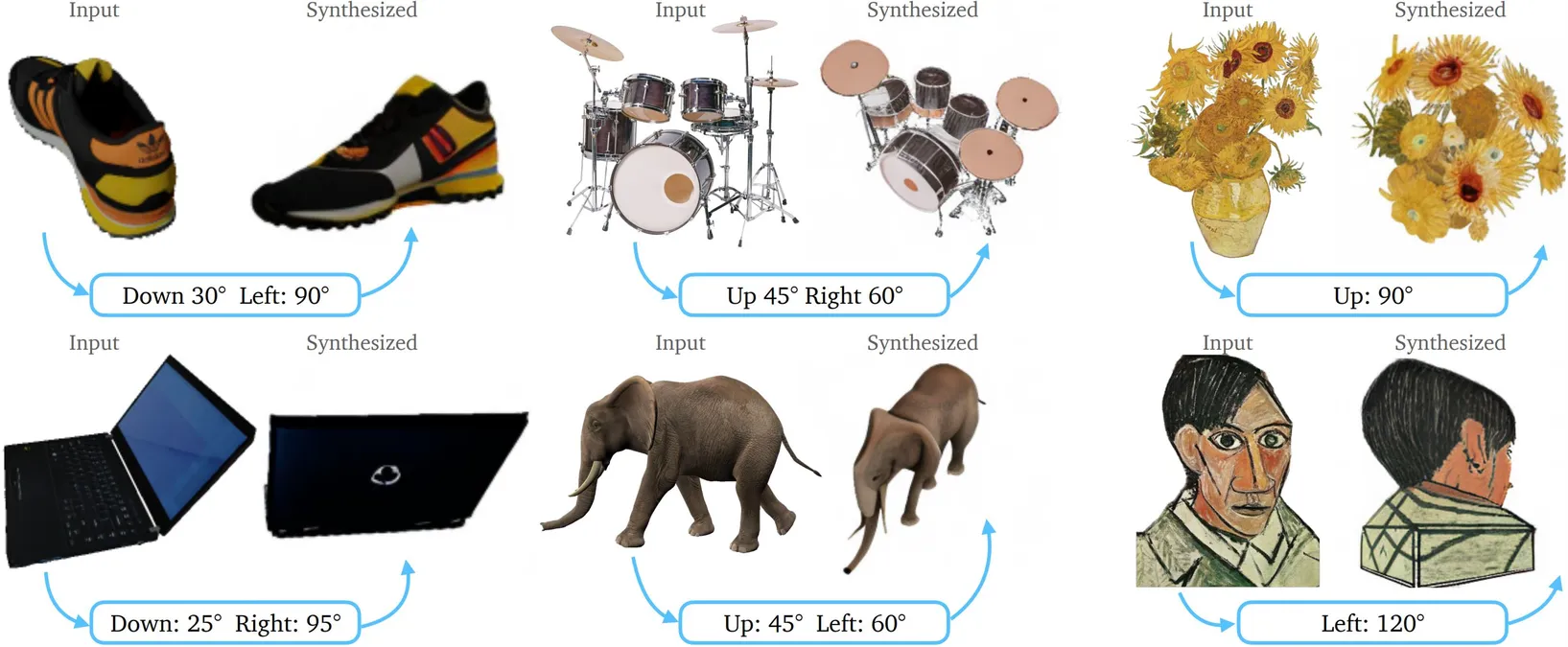
Zero-1-to-3 is an open-source method from Columbia University for zero-shot novel view synthesis. Give it one image and a target camera angle, and a fine-tuned Stable Diffusion model draws the new view. Novel view synthesis means creating pictures from viewpoints the camera never saw. Those views then feed 3D reconstruction pipelines. Its explicit viewpoint modeling reduces the Janus problem of multi-faced outputs. Code is MIT-classified on GitHub. Four checkpoints are released, with 105000.ckpt as the default. Check the repo for setup steps.
Key Features
1. Zero-Shot View Synthesis
No per-object training is needed. One image plus a relative camera pose yields plausible new viewpoints.
2. Camera-Pose Conditioning
Elevation and azimuth inputs explicitly model the viewpoint. This fundamentally reduces the Janus multi-face problem.
3. 3D Reconstruction Paths
Views feed SJC pipelines with Voxel NeRF, and marching cubes exports the mesh. Stable-Dreamfusion integration is documented.
4. Four Checkpoints
Releases include 105000, 165000, 230000, and 300000.ckpt files. The default is 105000; longer training may overfit.
5. Training Script
A preliminary fine-tuning script is included. Stable training wants large batches across eight 80GB GPUs.
6. Live Demo
A Hugging Face Space demo runs the model online. It uses about 22 GB of VRAM per the README.
Frequently Asked Questions (FAQ)
Does it make a mesh directly?
No. It synthesizes novel views first; meshes come from downstream SJC NeRF reconstruction plus marching cubes.
What is the Janus problem?
Text-to-3D models often grow extra faces. Zero123's explicit viewpoint conditioning fundamentally alleviates it.
Which checkpoint should I use?
The default 105000.ckpt. Longer-trained checkpoints were not verified to be better and may overfit.
What GPU do I need?
The demo uses about 22 GB of VRAM, runnable on RTX 3090 or 4090 cards. Training needs eight 80GB GPUs.
What input does it need besides the image?
An estimate of the photo's elevation angle, used to condition the view synthesis.
Conclusion
Zero-1-to-3 pioneered zero-shot novel view synthesis with explicit camera control. Single-image views plus SJC reconstruction open practical 3D paths. It suits researchers studying view synthesis and 3D generation. The repo is MIT-classified and free to use. Start with the hosted demo to see viewpoint control in action. Check the GitHub page for checkpoints, the demo, and training scripts.
Keep exploring
Similar AI tools
Ranked by the job they do, their capabilities, and how closely they fit this workflow.