
Upvotes
0
Pricing
Open Source
Category
Text-to-Speech
In the database since
Oct 2026
Overview
About Bark
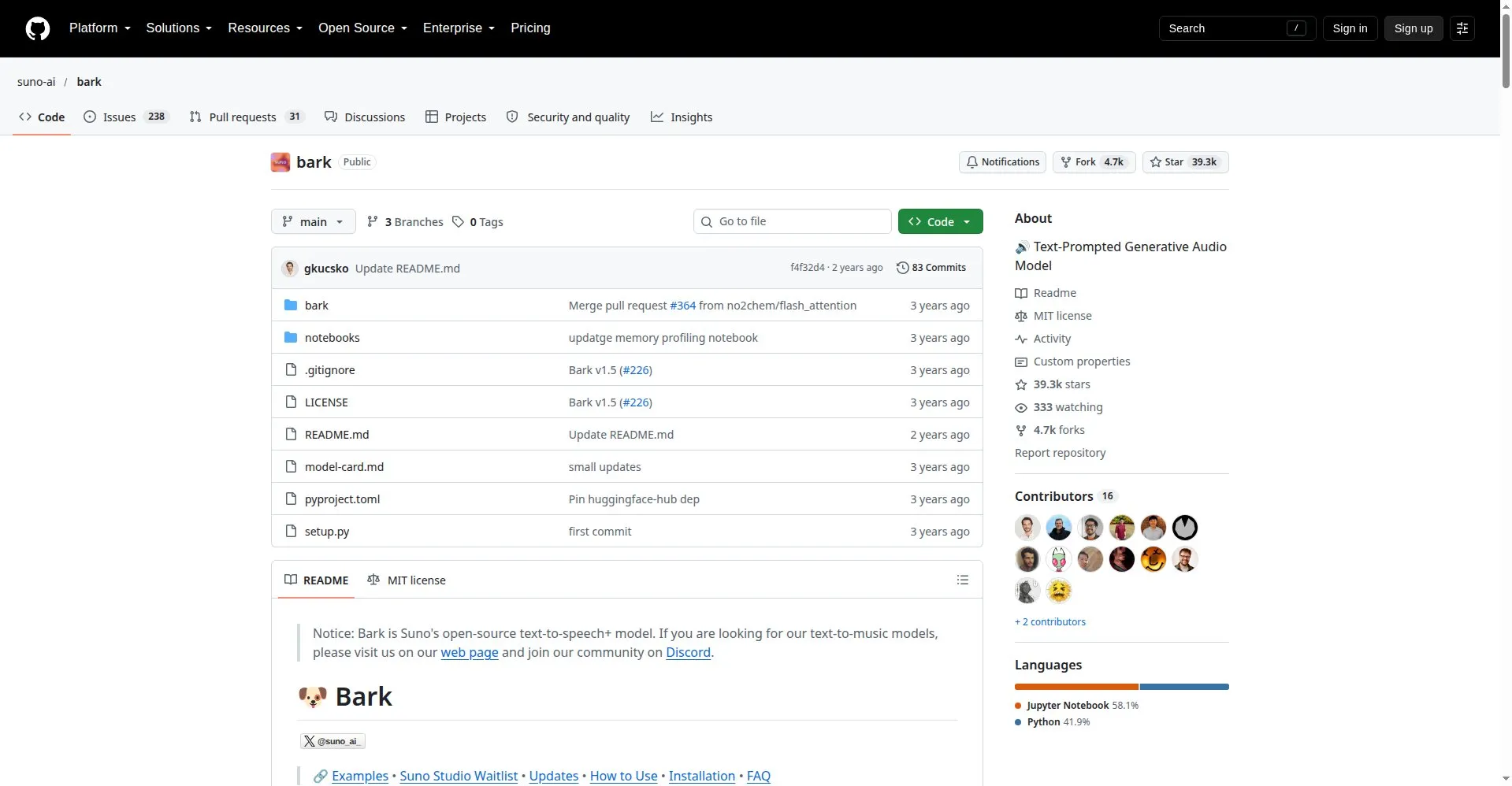
Bark is an open-source text-to-audio model created by Suno, the company behind the Suno music platform. It turns a text prompt into audio — not just speech, but also music, sound effects, laughter, and sighs. The model is fully generative, creating sound directly from your words with no intermediate step. Developers and tinkerers run it locally to build voice apps, experiment with audio, or study generative models. Because it is MIT-licensed, anyone can use it for free, including in commercial products.
Key Features
1. Generative Text-to-Audio
Bark converts text straight to audio without phonemes. It can output speech, music, background noise, and sound effects from one prompt.
2. Nonverbal Sounds and Singing
Type [laughs] or [sighs] to get laughs and sighs. Wrap words in ♪ symbols to make Bark sing the lyrics instead of speaking them.
3. 13 Supported Languages
Bark speaks English, German, Spanish, French, Hindi, Italian, Japanese, Korean, Polish, Portuguese, Russian, Turkish, and Chinese. It detects the language from your text.
4. 100+ Speaker Presets
Pick from over 100 ready-made voices across the supported languages. Each preset matches the tone, pitch, and accent of the chosen speaker.
5. Code-Switching
Mix two languages in one prompt and Bark keeps each part's native accent. A German line inside English text still sounds German.
6. Local and Private Inference
Bark runs on your own machine via Python. No API key is needed, and your audio data never leaves your computer.
7. Transformers Integration
The model ships in the Hugging Face Transformers library as suno/bark. You can load it with AutoProcessor and BarkModel in a few lines of code.
Frequently Asked Questions
How is Bark different from normal text-to-speech?
Normal text-to-speech converts phonemes into clean speech. Bark is a fully generative model that turns text directly into audio, so it can also make music, sound effects, and nonverbal sounds.
Does Bark support voice cloning?
No. The official model does not offer custom voice cloning. It provides 100+ speaker presets and can generate random voices that fit your text. Community projects have added cloning on top.
How long can the generated audio be?
About 13 to 14 seconds of speech per generation by default. The project includes a notebook showing how to chain outputs for longer narration.
What hardware do I need to run Bark?
The full model needs about 12 GB of VRAM. A smaller version fits in 8 GB of VRAM when you set SUNO_USE_SMALL_MODELS=True. It also runs on CPU, but much more slowly.
How do I install Bark?
Install it from GitHub with pip install git+https://github.com/suno-ai/bark.git. Do not run pip install bark — that installs a different, unrelated package.
Can I use Bark in a commercial product?
Yes. Bark is licensed under the MIT License, which permits commercial use at no cost. Suno adds that the model was built for research and can deviate from prompts.
Conclusion
Bark is a research-grade, MIT-licensed text-to-audio model from Suno. It suits developers and researchers who want expressive audio — speech, music, and sounds — running privately on their hardware. It is free for commercial use, needs a decent GPU, and results vary since it is a research release.
Keep exploring
Similar AI tools
Ranked by the job they do, their capabilities, and how closely they fit this workflow.