

Upvotes
0
Pricing
Open Source
Category
Text-to-Image
In the database since
Oct 2026
Overview
About Diffusers
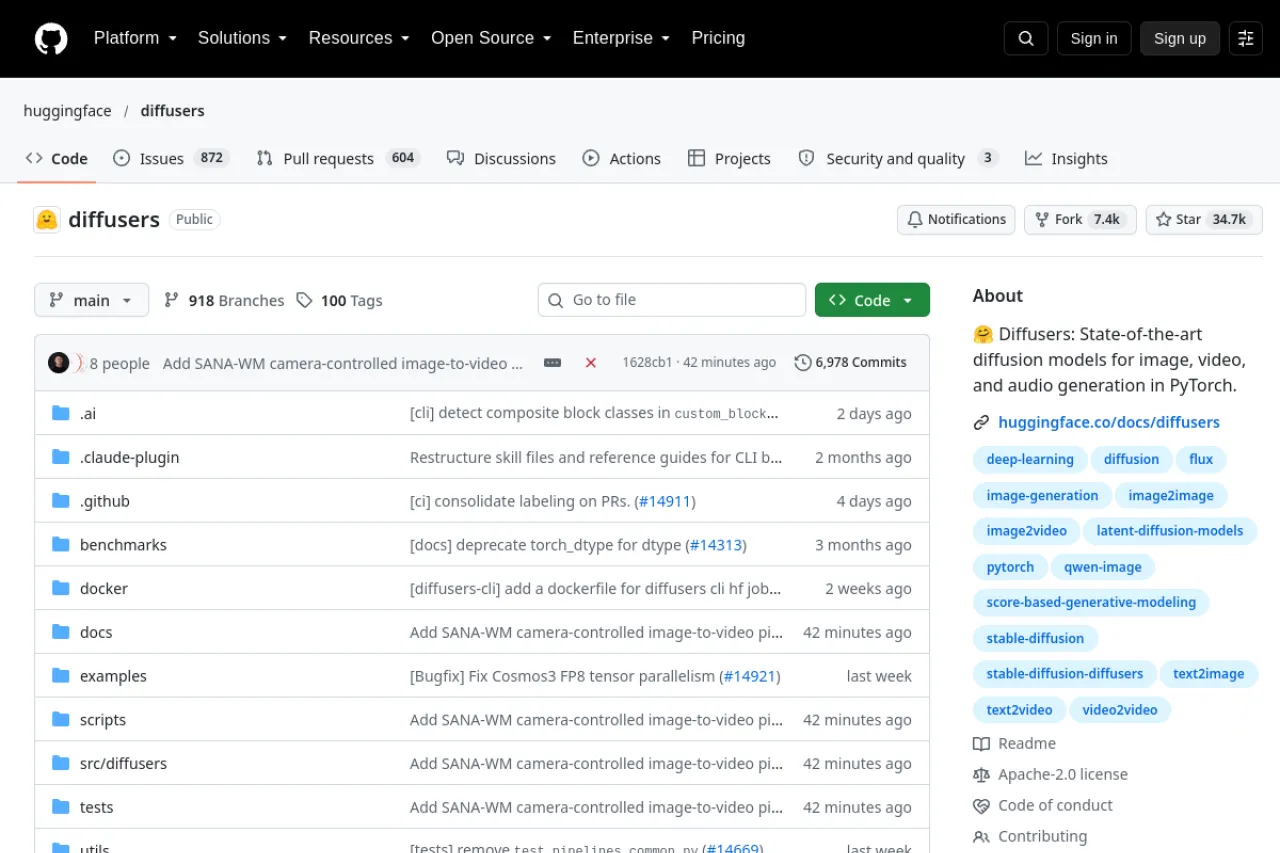
Diffusers is Hugging Face's open-source library for working with pretrained diffusion models. It gives you one simple interface to models that generate images, video, and audio. With a few lines of Python, you can run Stable Diffusion, Flux, or video models locally. The library handles the complex math of schedulers and pipelines behind the scenes. Researchers use it to test new ideas; developers use it to ship features. It pairs with the Transformers library for text models in mixed pipelines.
Key Features
1. One Interface
Pipelines give every model the same simple API. Learn once, then use dozens of models.
2. Images, Video, Audio
Diffusers covers text-to-image, video, and audio generation. One library spans all diffusion media. New modalities arrive as researchers publish them.
3. Custom Pipelines
You can mix and match components to build custom flows. Researchers prototype new ideas fast.
4. Schedulers
Many sampling schedulers trade speed for quality. Pick the one that fits your needs. Faster schedulers need fewer steps per image.
5. Training Scripts
Example scripts show how to fine-tune diffusion models. Adapt them to your own datasets. DreamBooth and LoRA examples are included.
Frequently Asked Questions (FAQ)
What is Diffusers used for?
Diffusers runs pretrained diffusion models for image, video, and audio generation. Developers use it to add generative features to apps.
How is Diffusers different from Transformers?
Transformers handles language and vision models; Diffusers handles diffusion models. Both are Hugging Face libraries with similar design.
Can I run Stable Diffusion with Diffusers?
Yes, Diffusers includes ready-made Stable Diffusion pipelines. A few lines of code generate your first image.
Do I need a GPU?
A GPU is strongly recommended for practical generation speeds. CPU works but is very slow for most diffusion models.
Can I train my own diffusion model?
Yes, the library includes training and fine-tuning scripts. DreamBooth and LoRA examples help you customize models.
Conclusion
Diffusers is the easiest way to work with diffusion models in Python. One clean API covers images, video, and audio, with strong docs and examples. It suits both researchers testing ideas and developers shipping features. The library is open source under Apache 2.0, backed by Hugging Face. Start with a text-to-image pipeline to see it work.
Keep exploring
Similar AI tools
Ranked by the job they do, their capabilities, and how closely they fit this workflow.