Real-Time Voice Cloning
Clone any voice from 5 seconds of audio sample
Upvotes
0
Pricing
Open Source
Category
Text-to-Speech
In the database since
Oct 2026
Overview
About Real-Time Voice Cloning
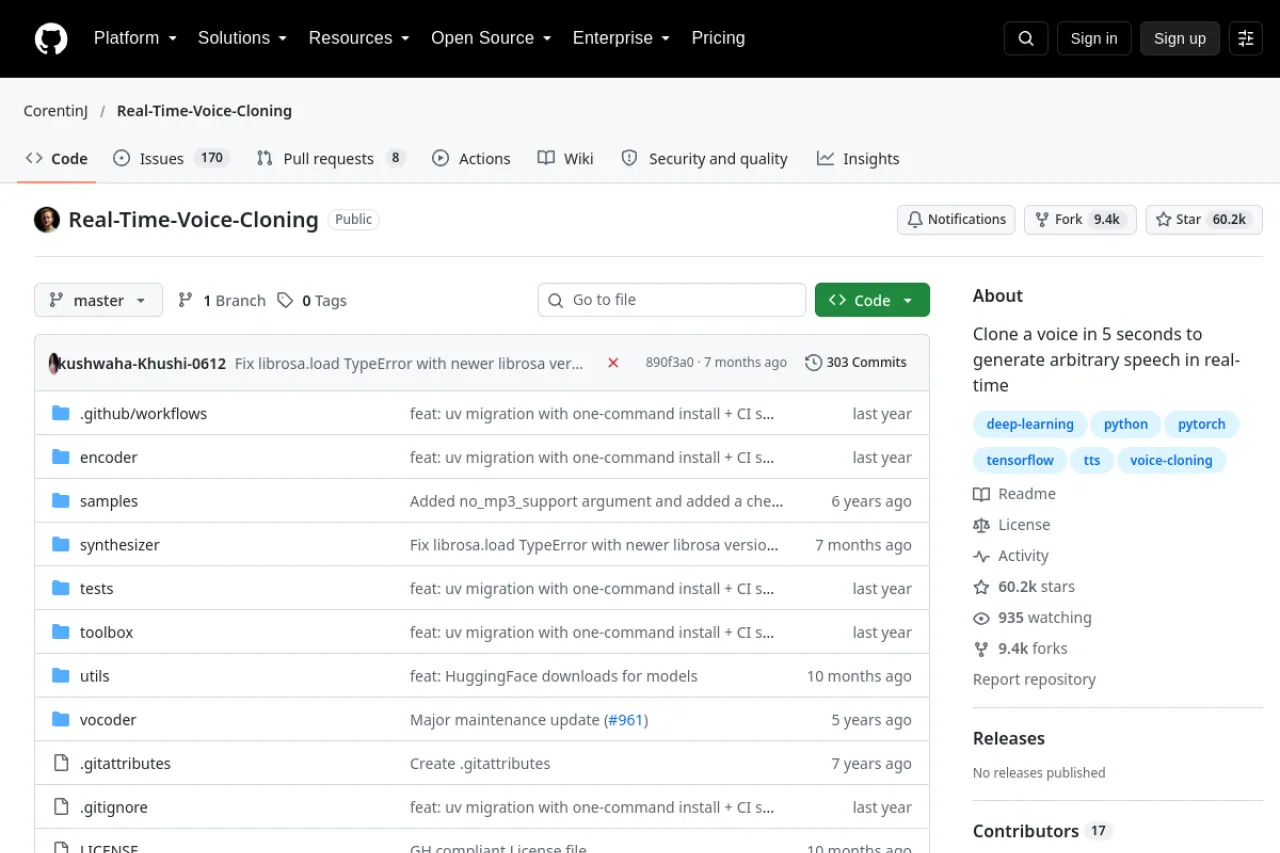
Real-Time Voice Cloning is an open-source toolbox that copies a person's voice from just 5 seconds of audio. You feed it a short sample, type any text, and it speaks the text in that voice almost instantly. The system has three parts: an encoder that captures the voice, a synthesizer that builds speech, and a vocoder that makes it sound natural. It runs in a simple desktop interface you control. Researchers and hobbyists use it to study modern speech synthesis.
Key Features
1. 5-Second Cloning
A tiny audio sample is enough to capture a voice. You do not need hours of recordings.
2. Real-Time Synthesis
Text turns into speech with almost no delay. You can hear results the moment you type.
3. Three-Stage Pipeline
Encoder, synthesizer, and vocoder each handle one job. The design is clear and easy to study.
4. Visual Toolbox
A desktop app lets you record, clone, and synthesize in one window. No coding is needed to try it.
5. Research Foundation
The repo is widely used to learn speech synthesis basics. Many newer projects build on its ideas.
Frequently Asked Questions (FAQ)
What is Real-Time Voice Cloning?
It is an open-source toolbox that copies a voice from 5 seconds of audio and speaks any text in it. It was built for speech synthesis research.
How much audio do I need to clone a voice?
Just 5 seconds of clear speech is enough for a basic clone. Longer, cleaner samples give better results.
Is voice cloning legal?
Cloning your own voice or with permission is generally fine. Cloning others without consent can break laws; always get permission first.
Do I need a GPU?
A GPU speeds things up a lot, but the toolbox can run on CPU. Expect slower synthesis without a graphics card.
What can I use it for?
Common uses include research, accessibility tools, and creative projects. Always respect privacy and consent when cloning voices.
Conclusion
Real-Time Voice Cloning made voice copying simple and fast. Five seconds of audio is all it takes to hear any text in a new voice. The three-stage design is a great learning tool for speech AI. It is open source for research use; clone voices responsibly and with permission. Check the README for demos and setup help.
Keep exploring
Similar AI tools
Ranked by the job they do, their capabilities, and how closely they fit this workflow.