Upvotes
0
Pricing
Open Source
Category
Coding Tools
In the database since
Oct 2026
Overview
About TRL
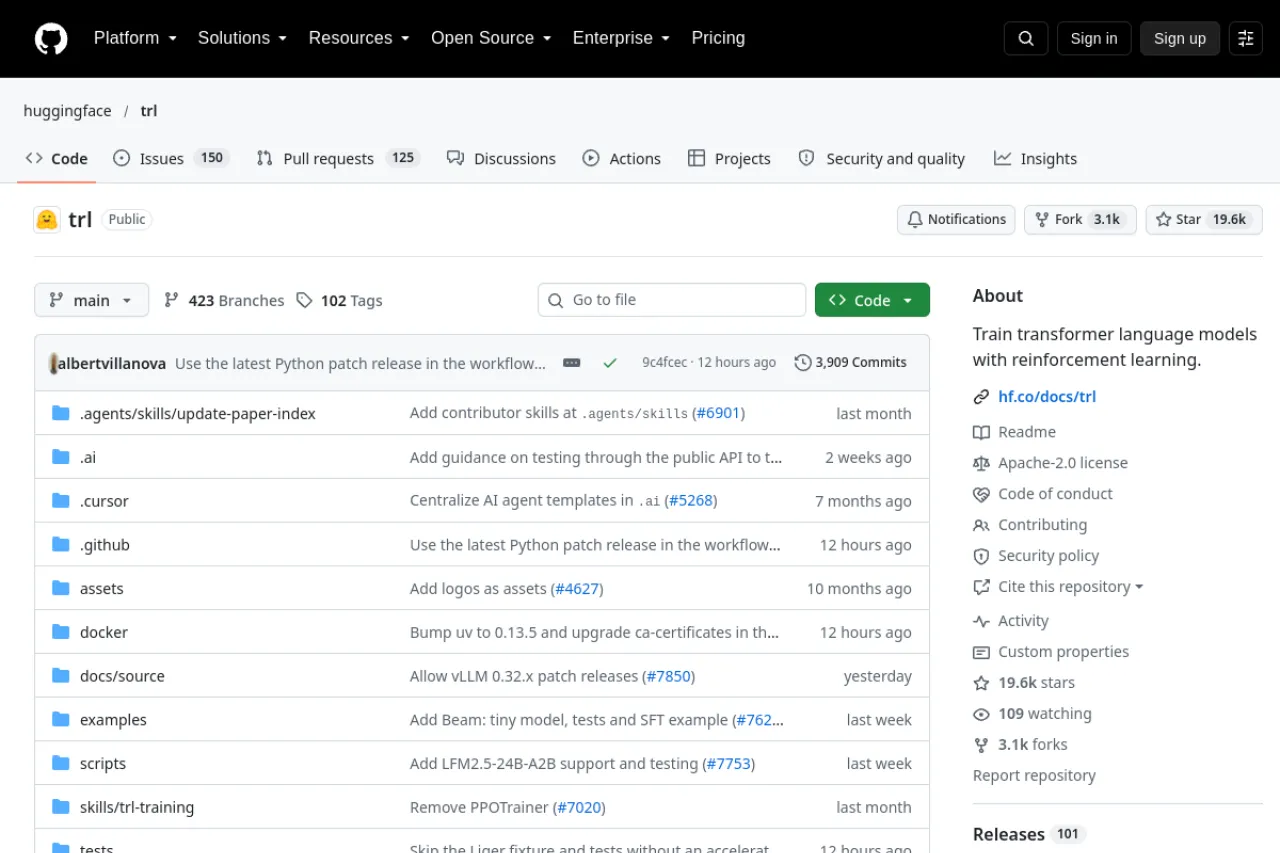
TRL is Hugging Face's open-source library for post-training language models. After pretraining, models need alignment: learning to follow instructions and match human preferences. TRL provides trainers for popular methods like RLHF (learning from human rankings) and DPO (a simpler, stable alternative). It works with Transformers and PEFT, so it fits your existing stack. Researchers use it to build chat models; companies use it to align products. Check the official docs for method guides and example scripts. Example scripts cover the full path from base model to chatbot.
Key Features
1. DPO Trainer
Direct Preference Optimization aligns models without complex RL. It is stable and easy to run.
2. GRPO Trainer
GRPO trains models from reward signals without a separate value network. It powers modern reasoning-model training and stays memory-light.
3. SFT Trainer
Supervised fine-tuning on instructions comes built in. It is the first step of most alignment recipes.
4. PEFT Integration
Combine alignment with LoRA for low-memory training. Big models align on single GPUs. This makes advanced methods affordable for everyone.
5. Example Scripts
Ready scripts show full alignment pipelines. Adapt them to your data and models. Each script is documented line by line.
Frequently Asked Questions (FAQ)
What is TRL used for?
TRL post-trains language models with alignment methods like DPO and RLHF. It turns base models into helpful assistants.
What is the difference between DPO and RLHF?
RLHF trains a reward model then optimizes with RL; DPO skips the RL step for stability. DPO is simpler, RLHF can be stronger.
Do I need a big GPU cluster?
No, PEFT integration lets you align models on single GPUs. Start small and scale as needed.
Can I use TRL with my own data?
Yes, trainers accept custom datasets in standard formats. The docs show how to prepare preference data.
Is TRL beginner friendly?
Supervised fine-tuning is approachable; RLHF takes more study. Follow the examples in order.
Conclusion
TRL is the standard toolkit for LLM alignment. It packages cutting-edge methods into trainers anyone can run. From instruction tuning to full RLHF, it covers the post-training journey. The library is open source under Apache 2.0, backed by Hugging Face. Start with SFT, then try DPO on your own preference data. The docs guide each step.
Keep exploring
Similar AI tools
Ranked by the job they do, their capabilities, and how closely they fit this workflow.