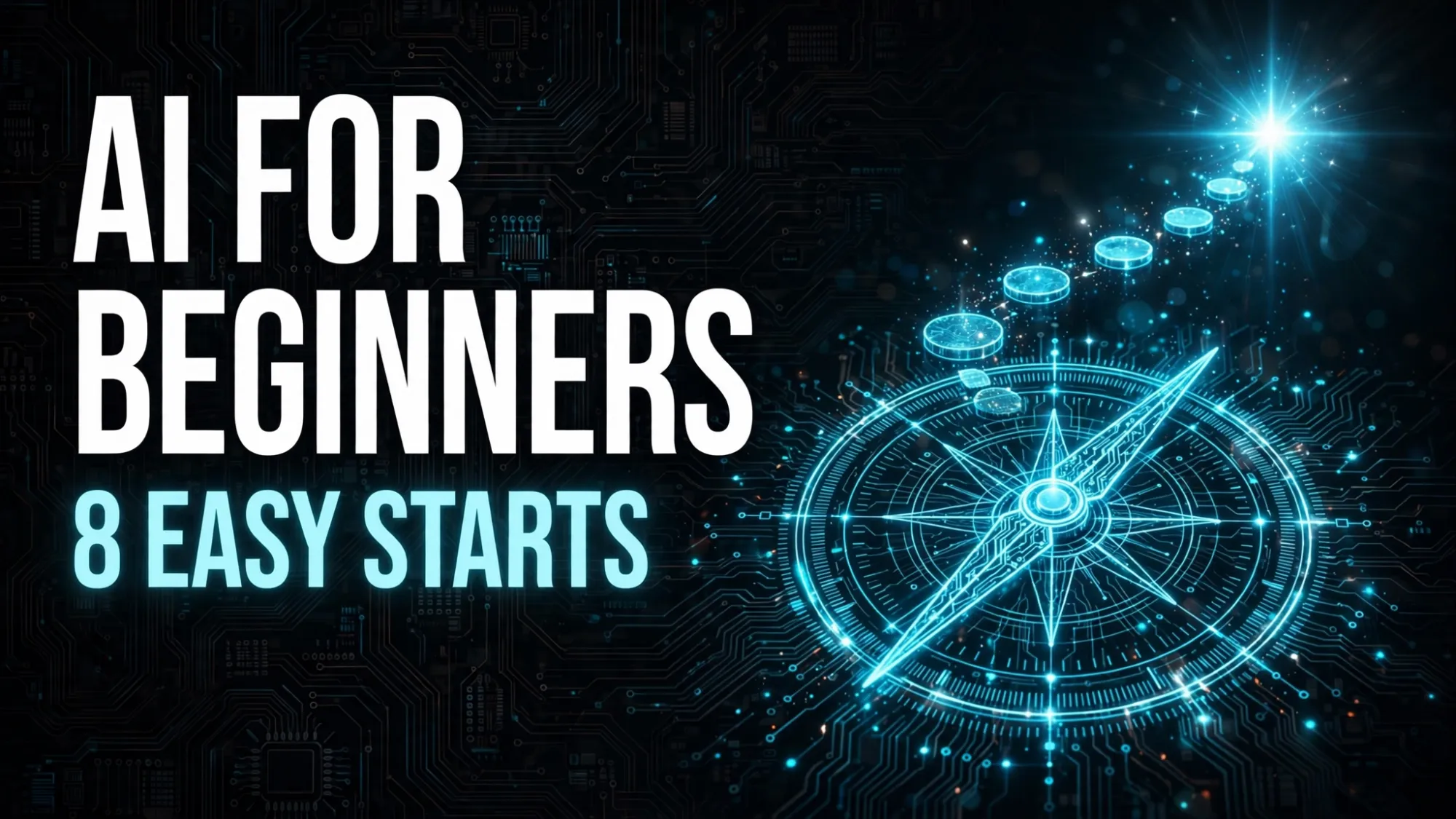
Starting with AI should feel exciting, not overwhelming. These 8 AI tools for beginners are easy to learn and free to start — compare free tiers, strengths, and trade-offs, then pick your first tool today.
Quick answer: ChatGPT is the best first AI tool for beginners — free, no learning curve, useful immediately. Canva makes design easy, Perplexity answers questions with sources, and CapCut edits video with templates. Start with one, not all eight.
Beginner-friendly means: free to try, working in minutes, and helpful without tutorials. All eight tools here qualify.
How we checked
We judged beginner fit by signup ease, interface simplicity, and minutes-to-first-result, and read each free-tier's terms on its official site. What we did not test: long-term learning curves or advanced features. Free plans change, so verify before you commit.
Comparison: the 8 tools at a glance
| Tool | Free tier | What it does | Best for |
|---|---|---|---|
| ChatGPT | Yes — free plan | Chat, writing | First AI experience |
| Canva | Yes — free plan | Design | Easy graphics |
| Perplexity | Yes — free plan | Research | Questions with sources |
| CapCut | Yes — free plan | Video editing | Simple videos |
| Google Gemini | Yes — free plan | Chat, writing | Google users |
| Grammarly | Yes — free plan | Proofreading | Clean writing |
| Notion | Yes — free plan | Notes, docs | Getting organized |
| Claude | Yes — free plan | Chat, writing | Careful writing |
1. ChatGPT — Best First AI Tool
Price: Free plan; Plus is PKR 5,700/month.
Free tier
Free chat, writing, and brainstorming with no card.
Strengths
Nothing to learn — type and get answers. It handles the widest range of beginner tasks: emails, ideas, explanations, plans. The most help exists online for it.
Trade-offs
Free queues at busy times. Answers need fact-checking. It is easy to start, deeper to master.
Bottom line
The default first AI tool for a reason. Open it today.
2. Canva — Best Beginner Design Tool
Price: Free plan; Pro adds premium assets.
Free tier
Free templates and AI design tools, no card needed.
Strengths
Templates make anyone a designer in minutes. Pick one, edit text, export. Social posts and presentations look professional with zero skill.
Trade-offs
Premium assets need Pro. Designs can look template-y. Deep originality takes more work.
Bottom line
Design without the learning curve. A perfect second tool.
3. Perplexity — Best Beginner Research Tool
Price: Free plan with daily limits; Pro removes caps.
Free tier
Free answers with cited sources daily.
Strengths
Ask anything, get an answer with links — easier than search engines for beginners. No tab-hopping, no sifting. It teaches while it answers.
Trade-offs
Daily caps on free. It answers questions; it does not create long content. Niche topics get thin.
Bottom line
Research for people who hate researching. Ask and learn.
4. CapCut — Best Beginner Video Editor
Price: Free plan full-featured; Pro adds extras.
Free tier
Free templates, auto-captions, and effects on phone and desktop.
Strengths
Templates edit for you — add clips and export. Auto-captions with one tap. Beginners finish their first video within the hour.
Trade-offs
Template-dependent. Pro cloud features cost extra. Serious projects outgrow it.
Bottom line
Video editing that feels like playing, not working.
5. Google Gemini — Best for Google Beginners
Price: Free plan; Google AI Pro via paid tier.
Free tier
Free chat with Gmail and Docs integration.
Strengths
It works inside apps beginners already use. Summarize an email thread or draft a doc without leaving Google. Zero new habits to build.
Trade-offs
Best features need paid. Weaker standalone than ChatGPT. Fewer tutorials exist.
Bottom line
Google users get AI without changing anything. Effortless start.
6. Grammarly — Best Invisible Beginner Help
Price: Free plan; Pro adds tone help.
Free tier
Free checks in every app you type in.
Strengths
Install once — no learning whatsoever. It fixes mistakes as you type, everywhere. Beginners write more confidently immediately.
Trade-offs
Basic checks only on free. It corrects; it does not teach writing. Some false flags.
Bottom line
The easiest win on this list. Install it now.
7. Notion — Best Beginner Organizer
Price: Free for individuals; paid adds teams.
Free tier
Unlimited personal pages, free.
Strengths
Templates make starting easy — pick notes, tasks, or journal and go. It grows from simple to powerful as you learn. One place for everything.
Trade-offs
Blank pages overwhelm — always start from a template. AI features cost extra. Takes about an hour to feel natural.
Bottom line
Slightly more learning, hugely more organized. Worth the hour.
8. Claude — Best Careful Beginner AI
Price: Free plan; Pro is a flat monthly price.
Free tier
Free chats with generous document handling.
Strengths
Claude gives thoughtful, careful answers — great for writing that matters. Handles long documents well. A calm alternative when ChatGPT feels rushed.
Trade-offs
Daily free caps. Fewer integrations. Less hand-holding for absolute beginners.
Bottom line
Your second chatbot, for when care matters more than speed.
Your situation → best pick
| Your situation | Best pick |
|---|---|
| You have never used AI | ChatGPT |
| You need simple graphics | Canva |
| You have lots of questions | Perplexity |
| You want to try video | CapCut |
| You live in Google apps | Google Gemini |
| You want writing help silently | Grammarly |
| Your life needs organizing | Notion |
| You want careful, thoughtful AI | Claude |
Frequently asked questions
What is the best AI tool for beginners?
ChatGPT — free, no learning curve, and useful from the first message. It handles writing, questions, and ideas. Once comfortable, add Canva for design or Perplexity for research. One tool at a time is the beginner rule.
Are AI tools easy for non-technical people?
Yes. These eight tools assume zero technical skill — they work with plain language, templates, and familiar apps. If you can text, email, and browse, you can use all of them. Technical background is not required.
Which free AI tools should beginners try first?
ChatGPT first for general use, then Canva for visuals and Perplexity for questions — all free. That trio covers most beginner needs. Add others only after the first three feel natural, roughly a month in.
How do beginners learn AI tools fastest?
By doing real tasks, not watching tutorials. Pick one tool, use it for something you actually need, and learn prompting basics: be specific, add context, request a format. Real use teaches in days what courses take weeks to cover.
Is it safe for beginners to use AI tools?
Generally yes for everyday tasks. Do not share passwords, financial details, or sensitive personal data with any AI tool. Check facts before acting on them. Free tiers from established companies are safe to try.
When should beginners pay for AI tools?
Only after months of free use, when a specific limit blocks real work. Beginners who pay early usually buy before understanding their needs. Free tiers teach you what matters — let them guide any future spending.
Pick one, start today, and grow from there — for more options, browse Draqee's AI tools directory.